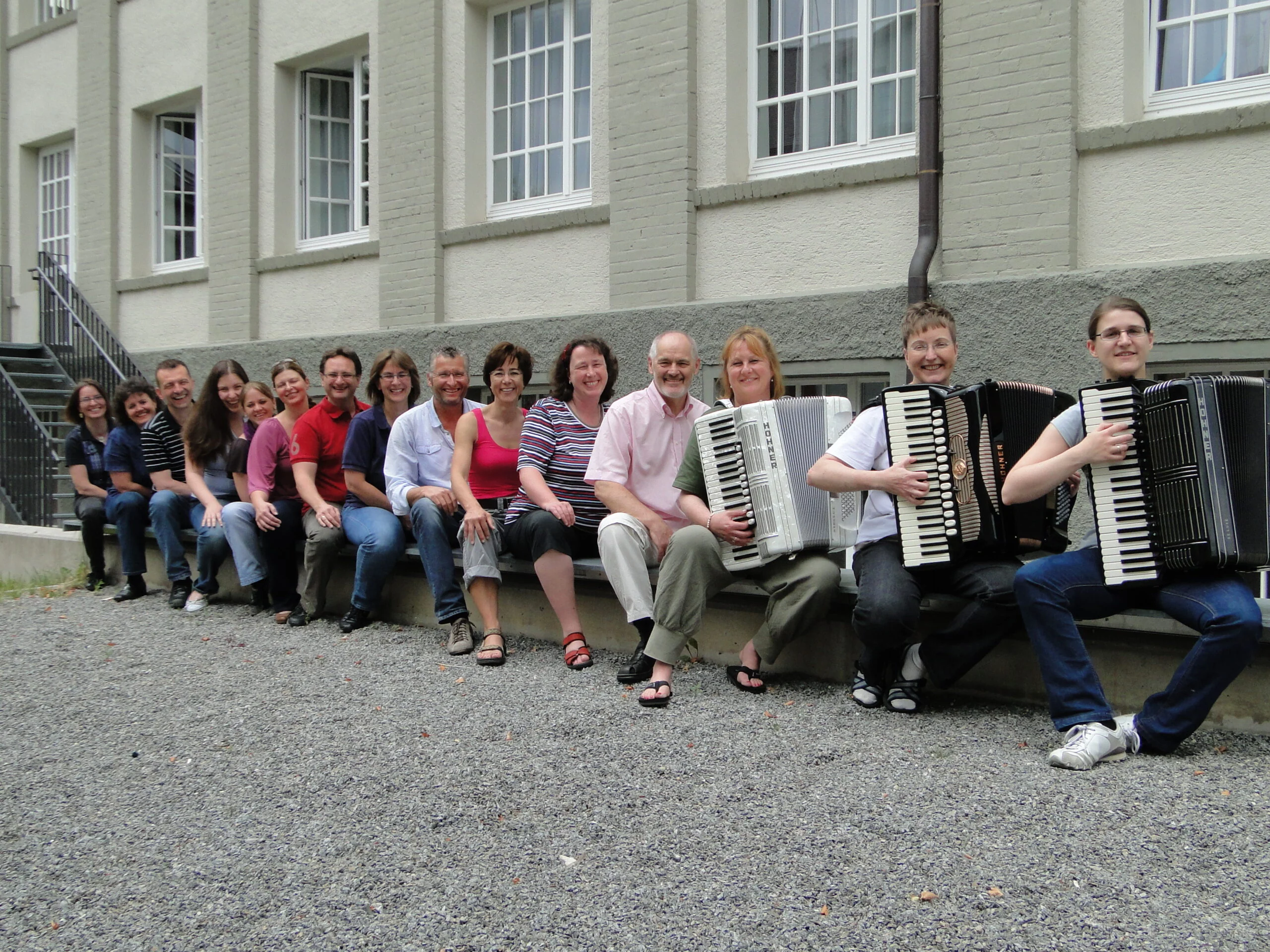
Part-time training (6 years)
Sharing music professionally – alongside work and everyday life
You want to gain qualifications without dropping everything? The part-time training at the Hohner Conservatory is structured so that you can combine your career, family and training in a manageable way – with a clear structure, practical relevance and personal support.
At a glance
- Goal: State-certifiedr accordion teacherin
- Duration: 6 years (part-time)
- Profile: about the elective module (Accordion II / Harmonica / Diatonic / EMP)
- Accordion I: Compulsory subject – beginners welcome with no prior knowledge required (individual tuition of 30 minutes per week)
- School fees: €1,200 per academic year (Installment plan available)
- Block phases: Weekends – dates published per school year
Why study while working?
- Work-life balance You stay in your job and build up your qualifications in parallel.
- Predictability Blockades at weekends – manageable in the long term.
- Practical relevance Mediation, methodology, theory and practice systematically interlock.
- Atmosphere: family-like, collegial, supportive – with helpful lecturers.
- On-site affordable accommodation in the immediate vicinity (for block release periods).
How the part-time vocational training works
The part-time training combines Block periods (weekends) with times for Independent study and preparation. About Over the course of 6 years, you grow step by step into practice, theory and pedagogy – within a framework that is realistically achievable alongside work.
Dates & Block Periods:
You can find the specific weekends on the events page.
Frequently Asked Questions
1. Prerequisites & Getting Started
Above all, you need motivation, reliability and a grounding in music. Whether you are suitable will be determined by the entrance examination (theory + practical depending on the profile).
Entrance examination & requirementsAccordion I is a compulsory subject and is structured in such a way that the transition even without prior accordion experience is possible. If you choose accordion as a profile (Accordion II), your accordion stand will be correspondingly more important – we will clarify this during the information session.
The entrance exam tests the basics of aural skills and music theory. You don't have to be „perfect“, but you should be willing to work on it – and prepare specifically.
Guides & Downloads2) Time model, block phases & compatibility with the job
6 years. That way, the training remains realistically manageable alongside a job and everyday life.
The block phases usually take place at the weekend. Whether you need additional annual leave depends on your job and your travel arrangements. Important: You can plan ahead because the dates are published for each academic year.
Dates & Block PeriodsThe exact weekends are listed on the events page for each school year.
Dates & Block Periods (Part-time)You have block modules (weekends) plus preparation/follow-up and independent study between sessions. We will discuss the realistic time commitment during the information session.
3) Costs & possible additional costs
The school fees are €1,200 per school year. Installment payments are available.
Depending on the situation, travel/accommodation and, where applicable, optional external offers may be added. We will discuss this transparently.
4) Entrance examination: content, duration, preparation
- Theory: Ear training, harmony
- Practice: profile-related (accordion / harmonica / diatonic)
- EMP without instrumental major subject: admission interview + practical aptitude test
That varies depending on the profile. You can find a rough guide on the „Entrance Examination & Requirements“ page.
Use our guides (e.g. „Passing the Entrance Examination Despite Having a Job“) and work with a clear, realistic plan.
Guides & DownloadsWhen we publish recommendations for repertoire/literature, you can find them at Entrance examination & requirements or receive information during the briefing.
5) Accordion: MIII / standard bass / learning path
Which bass type(s) make sense for you depends on your profile, your current level and your goals. We'll clarify that in advance during the information call.
No, optional. If it makes sense for your journey, it can be built optionally – matching your starting point.
6) Lessons, subjects, exams, qualification
You can find the subject overview on the „Training“ page under "Subjects & Content".
EducationExaminations are an integral part of the qualification pathway. Which parts are coming up and when is structured and communicated transparently as the course progresses.
The qualification consists of several parts. We'd be happy to explain the overall structure to you during the information session so that you have a clear idea from the very beginning.
- Accordion I: 30 minutes twice a week
- Accordion II (Profile): together with accordion I 45 minutes per week (also foldable to 1.5 hours every 2 weeks)
- Harmonica or diatonic accordion (profile): 30 minutes weekly or every 2 weeks for 60 minutes
7) Practical experience, performances, conducting, elementary music pedagogy (EMP) practice
No. There is no compulsion to perform. Practical formats can be part of the training, but always in the sense of a meaningful learning and teaching experience – not as an obligation to „get on stage“.
No. You can start without already teaching. Teaching practice is built up.
No. Conducting is taught as a subject.
For the elective Conducting II is it helpful if you already have a practice option or are setting one up in parallel.
We do not provide external practice groups as part of the package. For EMP, we recommend that you bring your own practical experience or actively build up practice in parallel (e.g. courses/projects/collaborations).
8) Benefits & Additional Offers
Depending on the offer and collaborations, there are possibilities. We are happy to discuss individually what makes sense at the moment.
Any questions?
If you want to briefly clarify what is realistic for you (profile, current status, time model, preparation), an information chat is the quickest way.
Your profile: accordion, harmonica, diatonic or EMP
Your qualification is clearly defined. Your profile is shaped through the optional module – so that later you can professionally pass on music in the exact area that suits you.
- Accordion Profile of Accordion II (Bonus: Accordion I + II)
- Harmonica Profile harmonica + accordion I as a basis
- Diatonic: Diatonic profile + accordion I as a basis
- EMP EMP profile (also possible without an instrumental profile subject) + accordion I as a basis
Important information regarding the placement (part-time)
EMP as a profile (part-time)
If you are in a part-time training course EMP If you select EMP as your profile, the following applies: We provide no external practice groups (e.g., fixed children's/group activities outside of school) as part of the training.
To ensure you can implement the content to the full, we particularly recommend EMP if you ...
- already practical experience of one's own you bring to group work / class or
- parallel active Setting up a practice (e.g. via your own courses, projects, collaborations).
If you are unsure how best to organise this: during the info chat we will briefly clarify what is realistic in your situation.
Elective Subject Conducting II
Conducting II is an elective subject with a strong practical focus. To ensure you benefit as much as possible, it is helpful if you …
- already lead an ensemble/orchestra or
- you in the course of a Practical training opportunity are setting up (e.g. small ensemble, amateur orchestra, project group).
That is not a „hurdle“, but a recommendation, so that the subject is genuinely useful to you in everyday life.
Entrance examination & application
There is a theoretical and one practical Entrance examination.
- Theory: Aural training, harmony
- Practice profile-related (accordion / harmonica / diatonic)
- EMP without an instrumental specialism: initial assessment interview + practical component
Preparation alongside working
To help you prepare, you will find guides and downloads that are particularly useful for working professionals (e.g. preparation for the entrance examination, planning, accreditation).
View guides & downloadsDo you want to know if the model fits your daily routine? Then let's figure that out in the information chat – concretely, realistically and without beating about the bush.